
ReinAgent
Reinforcement Agent
The first llm reinforcement AI agent to self-optimse through actions and trades.

LLM agents with Reinforcement Learning
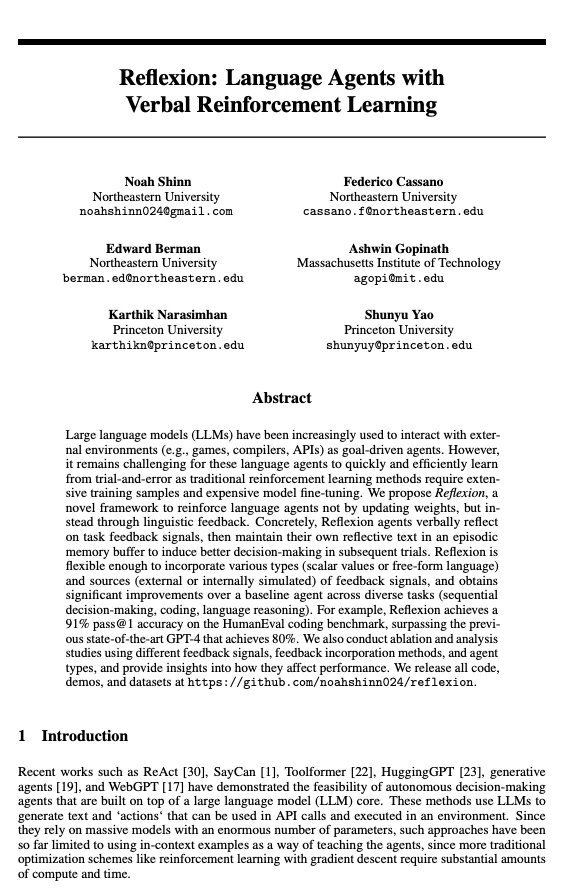
Large language models (LLMs) have been increasingly used to interact with external environments (e.g., games, compilers, APIs) as goal-driven agents. However,it remains challenging for these language agents to quickly and efficiently learn from trial-and-error as traditional reinforcement learning methods require extensive training samples and expensive model fine-tuning. We propose Reflexion, a novel framework to reinforce language agents not by updating weights, but instead through linguistic feedback. Concretely, Reflexion agents verbally reflect on task feedback signals, then maintain their own reflective text in an episodic memory buffer to induce better decision-making in subsequent trials. Reflexion is flexible enough to incorporate various types (scalar values or free-form language) and sources (external or internally simulated) of feedback signals, and obtains significant improvements over a baseline agent across diverse tasks (sequential decision-making, coding, language reasoning). For example, Reflexion achieves a 91% pass@1 accuracy on the HumanEval coding benchmark, surpassing the previous state-of-the-art GPT-4 that achieves 80%. We also conduct ablation and analysis studies using different feedback signals, feedback incorporation methods, and agent types, and provide insights into how they affect performance.
MonteCarlo Search
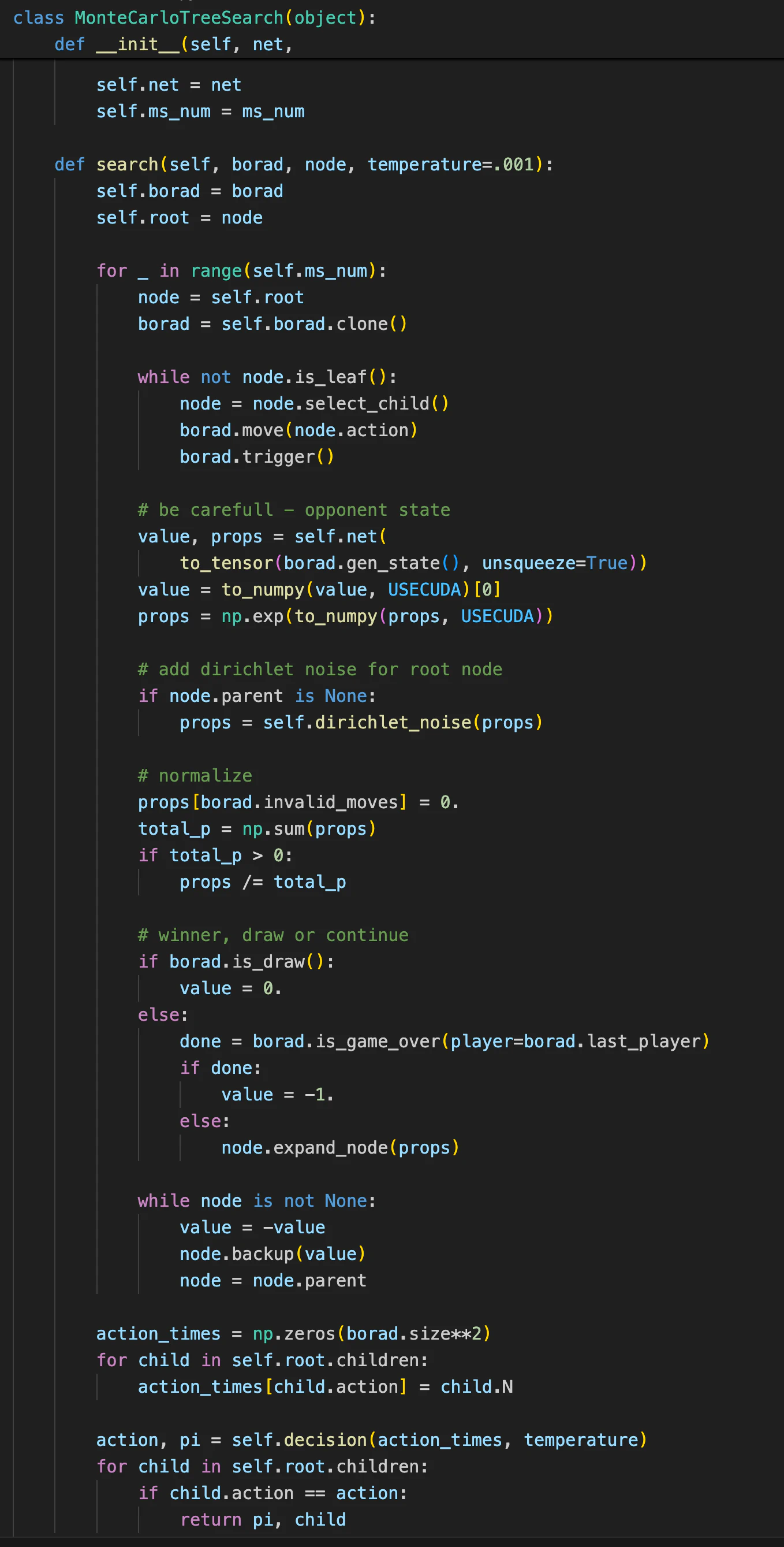
Monte Carlo Search is a powerful technique for exploring complex decision trees and making informed choices based on probabilistic outcomes. Its combination of random sampling and systematic tree exploration makes it particularly effective in uncertain environments.
Monte Carlo Search, often referred to as Monte Carlo Tree Search (MCTS), is a heuristic search algorithm used for decision-making processes, particularly in games and artificial intelligence. Here’s a breakdown of its main components and how it works:
Random Sampling: MCTS relies on random sampling of the decision space. It simulates many possible future scenarios by making random moves to estimate the potential outcomes of each action.
Tree Structure: The algorithm builds a search tree where each node represents a game state. The root node represents the current state, and child nodes represent possible future states after making a move.
Stay Up to Date
Sagittis scelerisque nulla cursus in enim consectetur quam. Dictum urna sed consectetur neque tristique pellentesque.